
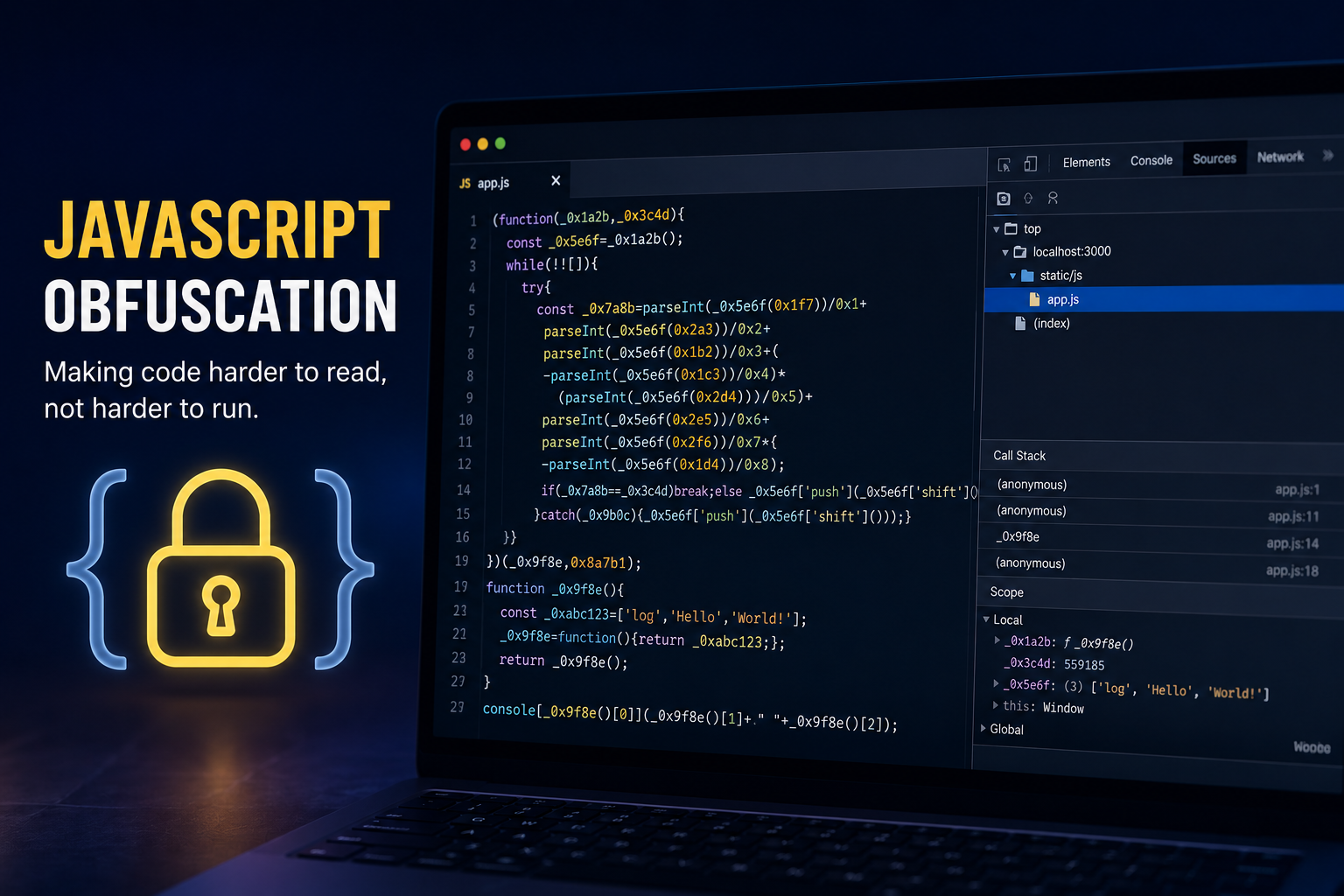
JavaScript powers a large portion of the modern web. Unlike backend languages, JavaScript code is delivered directly to the user's browser, making it relatively easy to inspect and analyze. This transparency is useful for development and debugging, but it can also expose sensitive business logic or proprietary algorithms.
JavaScript powers a large portion of the modern web. Unlike backend languages, JavaScript code is delivered directly to the user's browser, making it relatively easy to inspect and analyze. This transparency is useful for development and debugging, but it can also expose sensitive business logic or proprietary algorithms.
To make source code harder to understand, developers often use a technique called obfuscation.
In this article, we'll explore what JavaScript obfuscation is, how it works, its benefits, limitations, and when it should be used.
What Is Obfuscation?
Obfuscation is the process of transforming source code into a version that behaves exactly the same but is significantly harder for humans to read and understand.
Consider the following function:
function calculatePrice(price, tax) {
  return price + price * tax;
}
After obfuscation, it might look something like:
function _0x12ab(_0x1,_0x2){
  return _0x1+_0x1*_0x2;
}
The functionality remains unchanged, but the code becomes much more difficult to interpret.
The goal is not encryption. The browser must still execute the code.
Instead, obfuscation raises the effort required to reverse engineer the application.
Why Developers Obfuscate JavaScript
There are several reasons developers choose to obfuscate code.
Protecting Business Logic
Some applications contain proprietary algorithms that companies prefer not to expose directly.
Examples include:
- Pricing calculations
- Recommendation engines
- Data transformation logic
- Client-side licensing systems
Reducing Casual Copying
Without obfuscation, copying frontend code is often as simple as opening the browser's developer tools.
Obfuscation discourages casual code theft by making the code less readable.
Protecting Commercial Products
Developers who distribute JavaScript SDKs or browser-based products may use obfuscation to make reverse engineering more difficult.
Common Obfuscation Techniques
Modern obfuscators typically combine multiple techniques.
Identifier Renaming
Variable and function names are replaced with meaningless values.
Before:
const userName = "John";
After:
const _0x9a2f = "John";
This removes valuable context for anyone reading the code.
String Encoding
Strings are hidden and decoded at runtime.
Before:
console.log("Welcome");
After:
console.log(atob("V2VsY29tZQ=="));
The string remains accessible but is no longer immediately visible.
Control Flow Flattening
The original structure of the program is transformed into a more complex execution path.
This makes it harder to follow the application's logic and understand how functions interact.
Dead Code Injection
Additional code is inserted that never affects execution.
Example:
if (false) {
  console.log("Never executed");
}
Large amounts of dead code can significantly increase analysis difficulty.
Popular JavaScript Obfuscation Tools
Several tools are commonly used in production environments.
JavaScript Obfuscator
One of the most popular open-source solutions.
Features include:
- String encoding
- Control flow flattening
- Dead code injection
- Identifier renaming
Terser
Terser is primarily a minifier but also provides basic code transformation features.
Many React and Next.js projects use Terser during production builds.
UglifyJS
Historically one of the most widely used JavaScript optimization tools.
Although newer alternatives have emerged, it remains relevant in some projects.
Obfuscation vs Minification
Many developers confuse these concepts.
Minification
Minification focuses on reducing file size.
Example:
function hello(){console.log("Hello")}
The goal is faster downloads and improved performance.
Obfuscation
Obfuscation focuses on making code harder to understand.
The resulting file may actually become larger depending on the selected techniques.
These approaches can be used together.
Most production applications already use minification, while only some choose additional obfuscation.
Limitations of Obfuscation
Obfuscation is often misunderstood as a security mechanism.
It is not.
A determined attacker can still:
- Execute the code
- Debug the application
- Inspect network traffic
- Analyze runtime behavior
Since JavaScript must run on the user's device, it can never be completely hidden.
For this reason, sensitive secrets should never be placed in frontend code.
Examples include:
- API keys with privileged access
- Database credentials
- Private cryptographic keys
These belong on the server.
Performance Considerations
Aggressive obfuscation can negatively impact performance.
Potential drawbacks include:
- Larger bundle sizes
- Increased parsing time
- More memory consumption
- Harder debugging
For performance-critical applications, obfuscation settings should be tested carefully.
Should You Use Obfuscation?
The answer depends on your goals.
Obfuscation can be useful when:
- Distributing commercial JavaScript products
- Protecting proprietary client-side algorithms
- Making reverse engineering more expensive
Obfuscation is usually unnecessary when:
- Building standard business applications
- Creating internal tools
- Focusing primarily on performance
For most web applications, minification provides the majority of the practical benefits while keeping bundles small and maintainable.
Conclusion
JavaScript obfuscation is a technique designed to make source code more difficult to understand without changing its functionality. It can discourage casual code copying and increase the effort required for reverse engineering, but it should never be considered a replacement for proper security practices.
Because frontend code ultimately runs on the user's device, complete protection is impossible. The most effective strategy remains keeping sensitive operations on the server while using obfuscation only as an additional layer of protection when appropriate.
Used correctly, obfuscation can be a valuable tool—but understanding its limitations is just as important as understanding its benefits.