
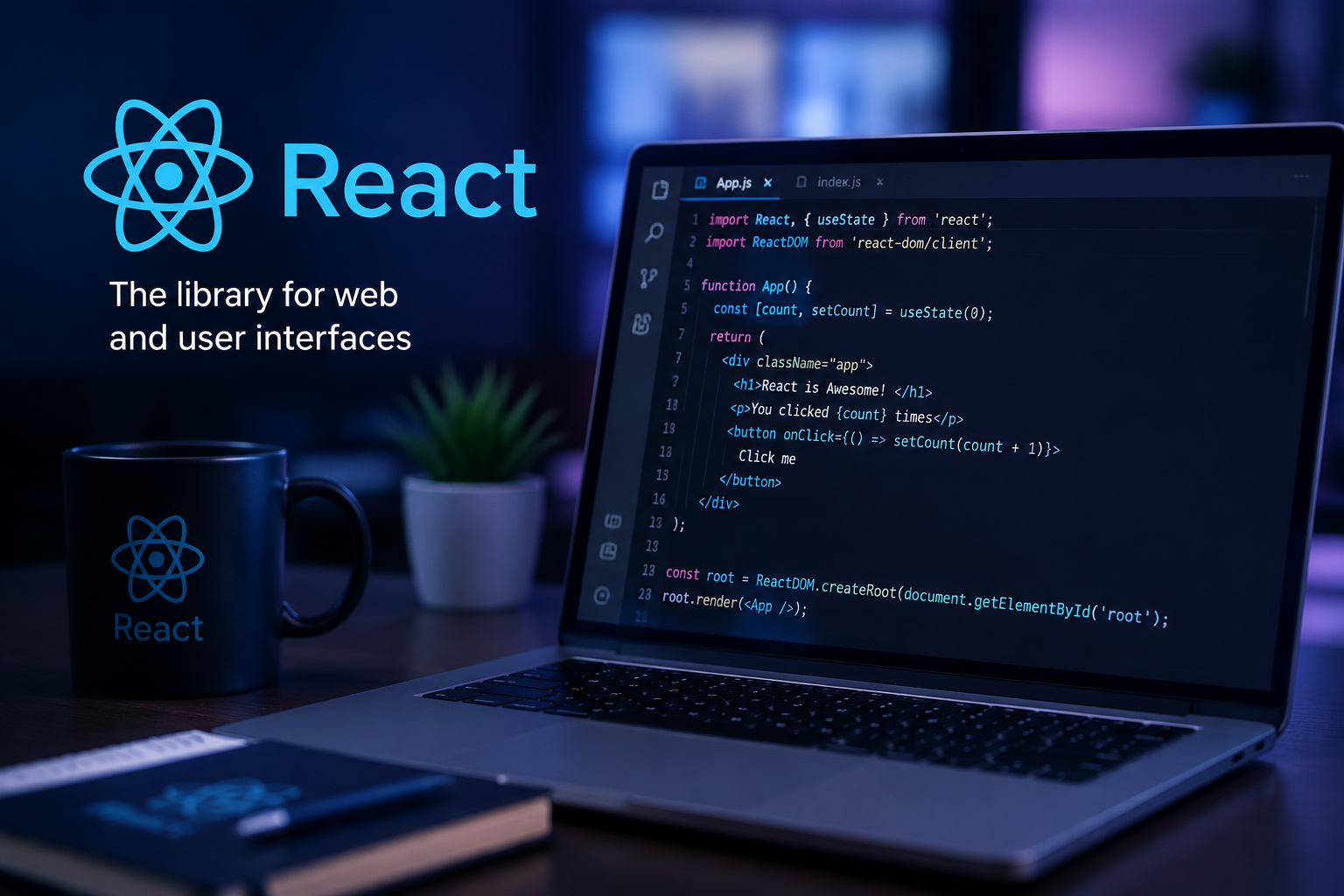
React has remained one of the most influential frontend technologies for nearly a decade. Despite the rise of new frameworks and changing trends in web development, React continues to power some of the world's most popular applications, from social media platforms to enterprise dashboards.
React has remained one of the most influential frontend technologies for nearly a decade. Despite the rise of new frameworks and changing trends in web development, React continues to power some of the world's most popular applications, from social media platforms to enterprise dashboards.
In 2026, React is no longer just a JavaScript library for building user interfaces. It has evolved into a mature ecosystem that enables developers to create fast, scalable, and maintainable web applications.
What Is React?
React is an open-source JavaScript library developed by Facebook (now Meta) for building user interfaces. It introduced a component-based architecture that changed how developers structure frontend applications.
Instead of managing large HTML pages and manually updating the DOM, developers create reusable components that describe how the interface should look based on the application's state.
A simple React component looks like this:
function Welcome() {
  return <h1>Hello, World!</h1>;
}
While this example is simple, the same concept can scale to applications with thousands of components.
Component-Based Architecture
One of React's biggest strengths is its component model.
Consider an e-commerce website. Instead of building a single large page, developers can split the interface into reusable pieces:
- Navigation Bar
- Product Card
- Shopping Cart
- Search Box
- Footer
Each component manages its own logic and can be reused throughout the application.
This approach improves:
- Maintainability
- Code organization
- Reusability
- Team collaboration
As projects grow, these advantages become increasingly important.
Virtual DOM and Performance
React introduced the concept of a Virtual DOM to improve rendering performance.
Traditionally, updating the browser's DOM can be expensive. React creates a lightweight representation of the DOM in memory and compares changes before updating the actual page.
This process allows React to:
- Minimize unnecessary updates
- Improve rendering efficiency
- Create smoother user experiences
Although modern frameworks use different optimization techniques, React's rendering model remains highly effective for large applications.
React Hooks Changed Everything
Before React 16.8, developers often relied on class components to manage state and lifecycle methods.
Hooks introduced a simpler approach.
Example:
import { useState } from "react";

function Counter() {
  const [count, setCount] = useState(0);

  return (
    <>
      <p>Count: {count}</p>
      <button onClick={() => setCount(count + 1)}>
        Increment
      </button>
    </>
  );
}
Hooks provide several benefits:
- Less boilerplate code
- Better code readability
- Easier state management
- Simpler logic sharing between components
Today, most modern React applications rely heavily on hooks.
The React Ecosystem
React's success is not only about React itself.
Its ecosystem includes powerful tools that solve common development challenges.
Next.js
Next.js has become the standard framework for React applications.
It provides:
- Server-side rendering (SSR)
- Static site generation (SSG)
- API routes
- Improved SEO
- Optimized performance
Many companies now choose Next.js as their default starting point when building React projects.
React Query
Managing server state can quickly become complicated.
React Query simplifies:
- Data fetching
- Caching
- Background updates
- Loading states
- Error handling
It allows developers to write cleaner and more reliable applications.
Zustand
As applications grow, state management becomes more important.
While Redux remains popular, many teams have adopted lighter alternatives such as Zustand due to its simplicity and minimal boilerplate.
Why Companies Still Choose React
Several factors contribute to React's continued popularity.
Large Talent Pool
Finding React developers is easier than finding developers specialized in many newer frameworks.
Strong Community
React has one of the largest open-source communities in software development.
This means:
- Extensive documentation
- Thousands of libraries
- Educational resources
- Active community support
Long-Term Stability
Organizations prefer technologies with proven track records.
React has demonstrated long-term stability while continuously improving through new features and performance enhancements.
Common Mistakes React Developers Make
Many developers encounter similar issues when working with React.
Overusing State
Not every value needs to be stored in state.
Excessive state management can create unnecessary re-renders and complexity.
Premature Optimization
Developers often use memoization tools such as useMemo and useCallback before identifying actual performance bottlenecks.
Optimization should be driven by measurement rather than assumptions.
Large Components
Components that handle too many responsibilities become difficult to maintain.
Breaking large components into smaller reusable pieces generally leads to cleaner code.
The Future of React
React continues to evolve.
Recent developments have focused on:
- Better server rendering
- Improved developer experience
- React Server Components
- Enhanced performance
- Reduced client-side JavaScript
As web applications become more complex, React's flexibility and ecosystem position it well for future growth.
While newer frameworks continue to introduce innovative ideas, React remains one of the safest and most productive choices for building modern web applications.
Conclusion
React has earned its place as one of the most important frontend technologies in the industry. Its component-based architecture, powerful ecosystem, and strong community make it a reliable choice for projects of all sizes.
Whether you're building a personal project, a startup MVP, or a large-scale enterprise application, React provides the tools needed to create modern, maintainable, and high-performance user experiences.
For developers looking to invest in a frontend technology in 2026, React remains a skill worth learning and mastering.